

Why Skool Growth Boost got my attention
My community is only $9/month, and Skool Growth Boost brought me 45 customers and almost 3,000 views. That is wild for a creator community. Naturally, I started wondering: how much is Skool spending on ads to make that happen?
I looked into the Facebook Ad Library and used Claude to help reason through the ad economics. The rough estimate I got was that Skool may be spending around $8 to acquire one customer for my community. This is an estimate, not official Skool data, but it is useful for understanding the business logic.
The basic math
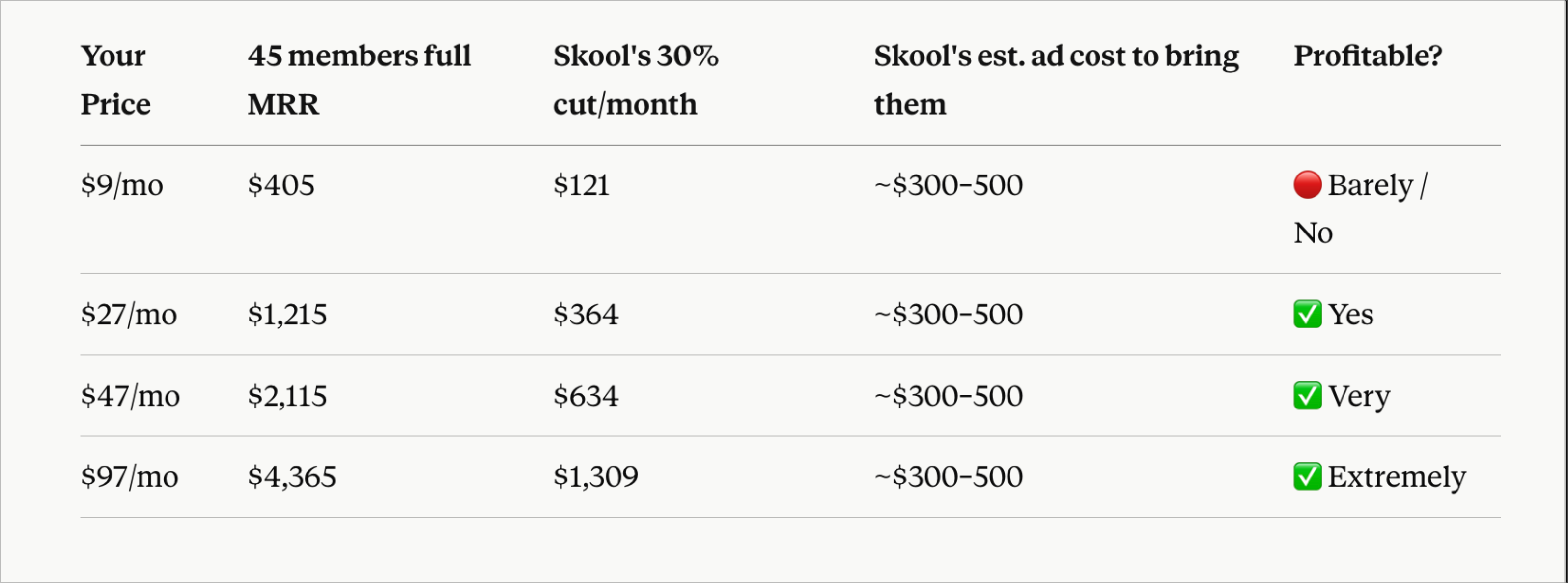
At $9/month, 45 full-paying members equals $405 in monthly recurring revenue. If Skool keeps 30%, that means Skool's share is about $121/month from those 45 members.
If the ad cost to bring those customers is around $300-$500, then Skool does not necessarily become profitable on that cohort in month one. They need those members to stay. This is where retention becomes the real game.
Why the $9 price is tricky
At $9/month, Skool earns about $2.70 per member per month from the 30% cut. If the estimated acquisition cost is about $8 per customer, then Skool needs roughly three to four months of retention before that customer becomes clearly profitable.
That does not mean $9 is bad. Low pricing can reduce friction, increase conversions, and help a community start moving. But if a platform is paying to acquire members for you, low pricing makes retention much more important.
The two options
Based on this research, I see two obvious ways to keep feeling the Growth Boost love.
Option 1: increase the community price to $27/month
At $27/month, 45 members creates $1,215 in MRR. Skool's 30% cut is about $364/month. If the estimated ad cost for the cohort is around $300-$500, the payback period becomes much healthier. In some cases, the cohort can become profitable close to month one.
Option 2: keep retention high
If I keep the $9/month price, then retention becomes the lever. If members stay for four months or more, the economics start to make more sense. That means onboarding, weekly value, fast wins, community activity, and clear member outcomes are not just "nice to have." They are the entire model.
The creator lesson
Skool Growth Boost is not just free attention. It is a lesson in acquisition, pricing, LTV, and retention. When a platform helps acquire customers for a community, the creator still has to make the community good enough that people stay.
For creators, the lesson is simple: do not only celebrate signups. Watch price, conversion rate, retention, churn, member activation, and the actual value members get in the first 30 days.
What I am taking from this
Skool Growth Boost is incredibly impressive. Massive props to Sam, Alex, Kirby, and the Skool team. For small creators, this kind of distribution can change everything. But it also makes the business model very clear: either price high enough that acquisition pays back quickly, or retain members long enough that the platform and creator both win.
That is the magic behind the magic.
If you are learning AI video and want a community built around retention-worthy outcomes, check out AI Video Club. The whole point is to help members make better AI videos, get feedback, and turn the skill into content, clients, or income.